






















Comparing lenses — field curvature

Comparing lenses fairly is a technical challenge. I’ll be showing one reason for this in DAP, sometime in the not too distant future. I recently tested eight different 50mm lenses (5 brands). The results are revealing, showing just how hard it is to make a fair test.
Test results from resolution charts provide a narrow and often misleading snapshot of actual lens behavior: the only good way to understand lens performance is by making real images in the field, and even then distance and subject matter can make significant differences. I recommend against making any lens choices based on test charts alone.
Below is a test image as shot at f/2. The two circles represent the 10mm and 18mm offsets from optical center. The lens was focused at center.
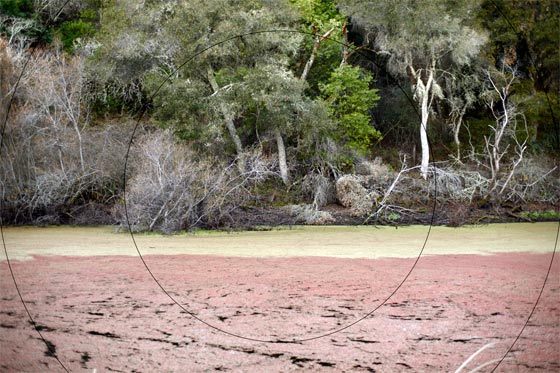
Entire frame at f/2, 50mm lens
Inscribed circles are at the 10mm and 18mm offsets
Consider the two crops below. Both are ~50 feet (16m) from the camera, and ~100 feet (32 meters) in front of the central focus point.
The sharper crop is at a ~16mm offset from optical center, and the other at the ~8mm offset, but both crops are at the same distance from the camera. Sharpness is not the issue so much as the uneven rendition, a ring of sharpness well off center, interacting with distance.
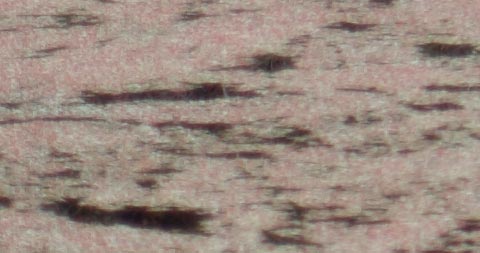
Near edge at f/2, 50mm lens
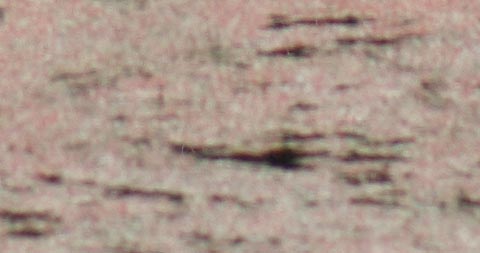
Entire frame at f/2, 50mm lens
Sharpness near center is not always better than elsewhere! It’s not a bad lens; results were cross-checked with other cameras and lenses. In fact, the difference is more pronounced with the better lenses (the ones with the highest MTF).
Wavy field curvature is the issue here, and when it interacts with distance, focus, focus shift and lens aberrations the results can be difficult to analyze with most subjects. Once you see this bizarre effect (more striking in viewing the entire image), the futility of casual lens tests or fixed distance resolution charts alone becomes clear.
A little stopping down is not a cure; at f/5.6 the effect is in some ways more visible, with the off-center crop nicely sharp and the more central one still blurry. Even f/11 doesn’t completely equalize the two.
The time is ripe for lens designers to give more importance to flat-field designs, especially as we move towards the 30 megapixel range in DSLRs.