


















Focus shift on a resolution chart

I previously reported on focus shift, and its importance when working with fast lenses (typically f/1.2 or f/1.4, but in some cases with f/2 or even f/2.8 lenses).
When testing lenses on a resolution chart (or similar high-detail subject), attention must be paid to focus shift. Shown below is an actual pixels crop, shot with the 21MP Canon EOS 1Ds Mark III and the Zeiss ZE 85mm f/1.4 Planar. Results will be the same for the Nikon-mount ZF 85/1.4 Planar. See Zeiss ZF Lenses.
Although not optimized for close-up, the Zeiss ZE 85/1.4 Planar is resolving to the limits of the sensor; it is not possible to cleanly resolve the “60” bars on the 1DsM3 at the distance this target was shot (a smidgen closer and yes it’s possible).
Contrast is low due largely to spherical aberration, which affects the image even at center, unlike other aberrations. Remarkably, corner performance is as sharp as the center (not shown). The result can be made to look much sharper with more sharpening (+3 was used in Canon’s DPP).
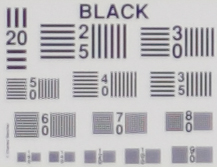
Actual pixels, f/1.4
(Canon 1Ds Mark III + Zeiss ZF 85/1.4 Planar)
At aperture f/2.8, depth of field partially compensates for focus shift, but leaves the image lacking contrast, though resolution is just maintained. The low contrast makes images look soft, because we perceive contrast even more than resolution. Also, the zone of sharpness will have moved to the rear of the desired focus point, possibly throwing off key subject matter, such as eyes or eyelashes. Having the inside of the eyeball sharp is of no value!
Compensating by 2cm for the focus shift (using a nodal slider), the difference in contrast is obvious, as are the clean black and whites. The zone of sharpness will be centered around the focus point as well.

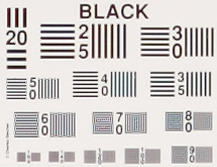
Actual pixels, f/2.8. No compensation (left), 2cm compensation (right).
Note that color is also affected; except for extremely well-corrected lenses, out-of-focus means that residual color aberrations affect color, especially on high-contrast edges.
Focus shift is an issue with many lenses, but not all. Why not subscribe to DAP and get the scoop on a wide variety of lenses?
