



















The zipper effect

I first reported on what I called the “zipper effect” way back in 2005 in my D2x vs EOS review (still well worth reading). Call it the “zipper effect”, the “jaggies” or the “staircase effect”—it isn’t pleasing—but might not matter much for prints.
Mouse over the example below. The original was converted in Canon’s Digital Photo Professional with sharpening level 2. Mouse over to see what happens after applying Photoshop Smart Sharpen {200, 0.5}, a level of sharpening that is not at all unreasonable for a large print. Observe especially the shadows at left with the striped appearance—rather odd, probably an artifact of today’s sensor technology—scanned film won’t show such striping. Yet another reason a non-Bayer (non-interpolated) sensor would be a Very Good Thing.
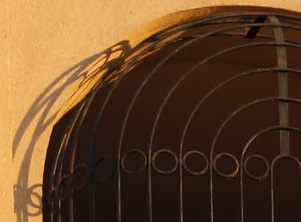
Canon 1Ds Mark III, actual pixels
Does it matter? Probably not at all in most size prints of most subjects, but there are always exceptions. I printed a section equivalent to a 36" X 24" print at 156dpi on my Epson R2400. The staircasing effect was visible upon close inspection, in fact unreasonably close inspection (and even more noticeable in the roof tiles). Such digital artifacts do have a visual impact even if they are not directly perceived. With luck, future sensors will move away from the path of ever-higher resolution, and instead move towards elimination of such artifacts, which will heighten the sense of “alive” in photographs.