



















Monochrome vs color filter array (Bayer) sensor

Related: Bayer, Bayer matrix color filter array, black and white, digital sensor
Following up on yesterday’s entry discussing the possibility of group buy of a monochrome medium format digital back, a color filter array (Bayer) sensor is compared with a monochrome sensor below (images courtesy of Pete Myers).
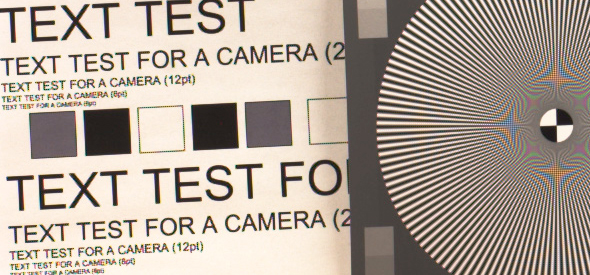
The images are from an eleven megapixel Kodak chip, and actual-pixels are shown. They are not an exact match in framing. The color image is slightly larger, so it it has a slight advantage over the monochrome sensor. Consider the actual-pixels crops below, then read on.
 Image
from color sensor
Image
from color sensor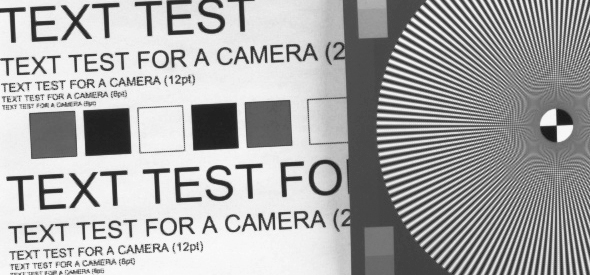 Image
from color sensor converted to grayscale
Image
from color sensor converted to grayscale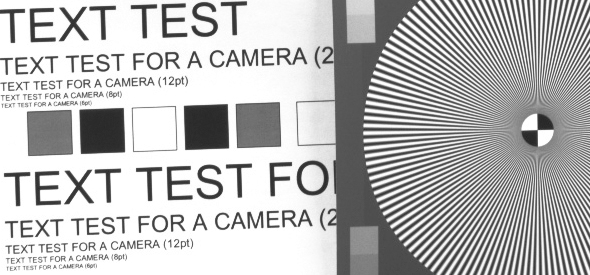 Image
from monochrome sensor
Image
from monochrome sensorThe stunning clarity of the monochrome sensor should be obvious at a glance. It has high accutance (edge sharpness) with few artifacts. The 6-point text is most revealing; what is difficult to read in the color sensor-derived image is clear and crisp in the monochrome sensor-derived image.
In case it’s not obvious, the tiny crop shown just below at 200% of actual pixels should make the differences easy to see; mouse over to see the monochrome sensor-derived version. The color sensor-derived version has an interlaced look to it—as if 1/2 the pixels were there—which indeed is the case, since 50% of the pixels are green, 25% blue and 25% red. This “color filter array” results in a loss of very fine detail in the interpolation process. Of course, color filter array RAW-file conversion is improving all the time, but there is no algorithm that can create non-existent data.

200% of actual pixels
One might gripe that there is a small difference between the two images above—bah humbug. So let us compare the color-sensor-derived image to the monochrome image—but first let’s downsize the monochrome one to 70% of its original size, then upsize it to the original size. In short, we are comparing a 5.5-megapixel monochrome image to an 11-megapixel color-derived image.

200% of actual pixels
The resampled monochrome image compares very favorably to the color-sensor-derived one’s full resolution. In short, a 16-megapixel monochrome digital sensor has the potential to produce images with the resolution of a 32-megapixel color sensor! But let’s not forget that a true 32-megapixel sensor demands considerably more resolution and contrast from the optics, not to mention more precise focus and careful attention to depth of field (to achieve twice the actual resolution). So it is not out of the question that in actual practice with real lenses and real subjects, a 16-megapixel monochrome sensor could perform more like a 40-megapixel color sensor! Now that’s an exciting prospect.
Additional advantages to a monochrome sensor are a “cleaner” image that will sharpen more easily with fewer artifacts, and image files that are 1/2 the size for comparable resolution (16 vs 32MP).
