




















Canon EF 400mm f/5.6L

I just purchased a Canon EF 400mm f/5.6L. I had wanted a long prime lens, especially one that performs in infrared, and I have to say I am pleased with the relatively compact size (for a 400mm lens), surprisingly low weight, and very convenient and sturdy built in lens shade. These are all are traits that mean it’s likely to be used regularly, rather than sitting home in a drawer. Brief field testing suggests that the lens is remarkably free of infrared hot-spot issues.
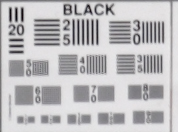
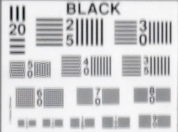
There’s only one problem: to my consternation, the lens performs no better than my EF 100-400mm f/3.5-5.6L zoom at f/5.6 and f/8. The zoom, despite a 3.6% disadvantage in magnification, is at least as good if not better than the prime! [Assuming the 400mm f/5.6L is exactly 400mm, the zoom is equivalent to 385mm]. The prime does offer lower distortion, slightly longer reach, and less chromatic aberration.
Especially given the 3.6% magnification disadvantage of the zoom (the tripod remained in a fixed position), I’m hard pressed to make any claim that the 400mm prime is better; in fact it appears to be inferior to the zoom in terms of contrast, and it has more astigmatism. Field shots confirm a slightly smeared look at f/5.6 and f/8, so I’m 90% certain the poor performance is not due to focus error.
| Center crop, actual pixels | |
|---|---|
Canon EF 100-400mm f3.5-f.6L @ f/5.6 |
Canon EF 400mm f/5.6L @ f/5.6 |
 |
 |
| Little or no astigmatism Near-equal horizontal and vertical resolution/contrast. |
Astigmatism Vertical resolution/contrast ≠ horizontal resolution. |
| Center crop, actual pixels | |
|---|---|
Canon EF 100-400mm f3.5-f.6L @ f/8 |
Canon EF 400mm f/5.6L @ f/8 |
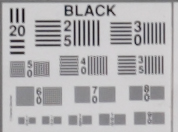 |
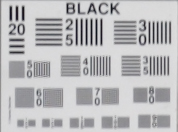 |
Only by stopping down to f11 does the prime outperform the zoom, but given the 3.6% disadvantage in resolution of the zoom, it’s not clear that the outperformance isn’t simply the slightly higher magnification; I’d call it a draw:
| Center crop, actual pixels | |
|---|---|
Canon EF 100-400mm f3.5-f.6L @ f/11 |
Canon EF 400mm f/5.6L @ f/11 |
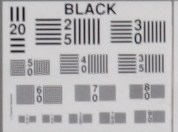 |
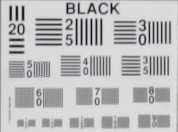 |
| Slight loss of contrast from f/8 indicates that the lens reached optimal performance at f/8. | Continued improvement in resolution/contrast to f/11 indicates a likely lens defect. |
The f/11 performance is how I’d expect the prime to perform at f/5.6; one uses a prime hoping to get excellent performance wide open, or near to it. The continued improvement by stopping down likely indicates an optically misaligned lens, or just a poor sample. I could detect no left/right or top/bottom inconsistency in performance, so focus error remains a possibility, though I did force refocusing 3 times with identical results. When a lens can’t focus accurately on a high contrast black and white target, it isn’t going to do so on a “real” subject! But 3 chances is two too many.
These conclusion are in direct contradiction to what Michael Reichmann reported a few years back with these two lenses. And they don’t jive with what ought to be observed. So I’m returning my sample to try another one.