

















|

|

|

|

|

|
Are your sunglasses protecting your eyes?

Related: clothing and footwear, eyesight, gear, health, infrared, sunglasses, ultraviolet
UPDATE July 2020: see Science Daily: Declining Eyesight Improved by Looking at Deep Red Light. IMO, it is still a good idea to block both UV and IR radiation from eyes, but that article suggests that exposure to sunlight (high proportion of infrared) for a few minutes in bright sunlight may be advisable.
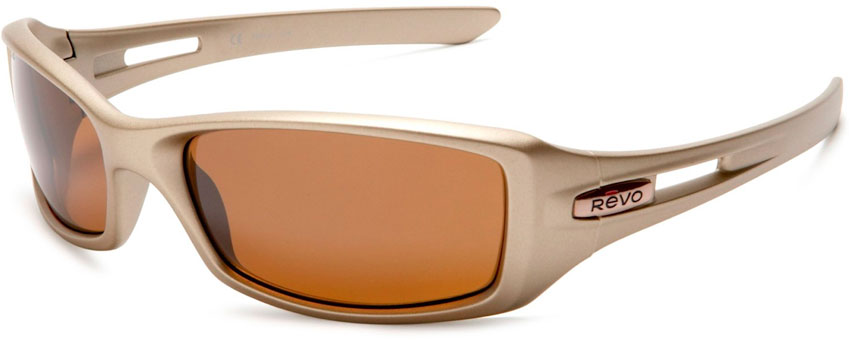
Cheap sunglasses @AMAZON can be fine, if they work. And the same goes for expensive ones. I personally prefer Revo Polarized sunglasses.
Update May 12, 2011: for cycling, I now prefer the Revo Redpoint sunglasses, or any shatter resistant Revo Serilium lens.
Update August 2016: see my review of Revo Guide S sunglasses.
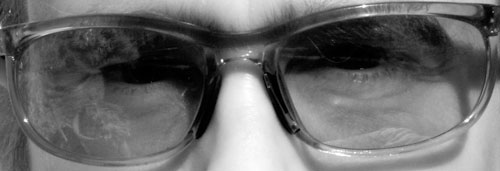
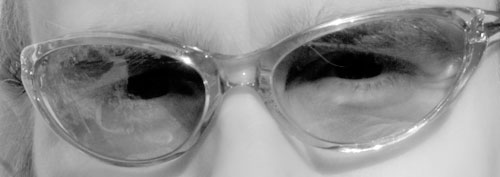
A friend of mine complained of irritated eyes after riding in afternoon sun for several hours. She was sure it wasn’t the wind. On a hunch, I photographed her using my Canon 5D-IR digital camera (see Digital Infrared). I also had her photograph me wearing a pair of Revo sunglasses, with glass polarized lenses, since the initial results with her sunglasses were so “clear”.
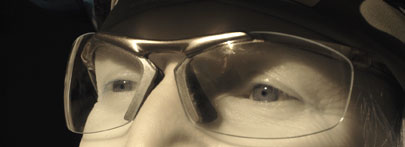
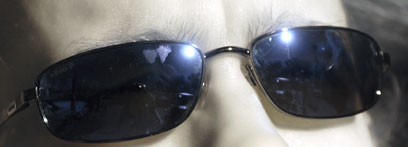
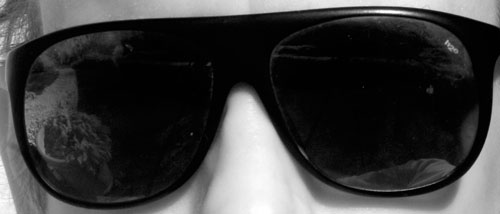
The results are startling! Consistent with the spectral transmission curve found on Revo’s web site, the Revo sunglasses attenuate infrared substantially, whereas the plastic* lenses simply allow the retinas to be fried, with their near-100% transmission. Such sunglasses might be worse than none at all, since they cause the pupils to dilate, thus allowing substantially more infrared to strike the delicate retinas, causing irritated and fatigued eyes. In essence, one stares at a bright light for hours—that’s gotta hurt!
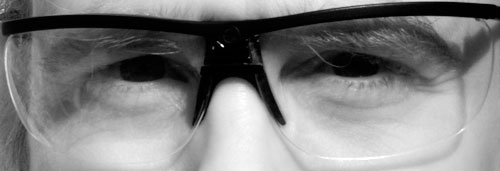
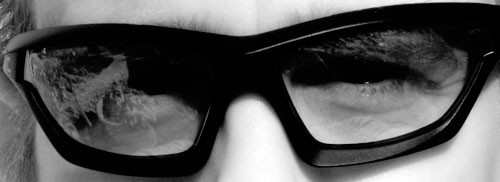
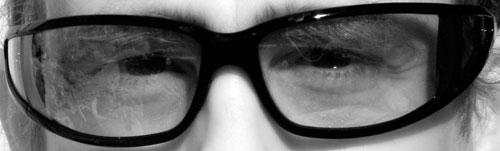
Intrigued, I shot a few frames with other sunglasses to see how they fared (see below). The only models that blocked infrared radiation acceptably well were the Revos. Even the glass-lens Maui Jim sunglasses with anti-reflective lens coatings fared poorly, blocking infrared by only a modest amount. Perhaps the outstanding infrared-blocking characteristics of the Revo sunglasses are due to the slight mirror finish. No mirrored lenses from other vendors were available to test.
[In the pictures below, observe the brightness of the skin near the mid-bottom of the right lens; other areas are shaded by eyebrows or the angle is different].
* plastic—a man-made material other than glass—eg polycarbonate, acrylic, etc
Of course, ultraviolet radiation is a more serious concern, because it can damage the retina and induce cataracts in the eye’s natural lens. Testing for ultraviolet transmission is a more complicated task. However, I had on a hand an ultraviolet LED flashlight from maxmax.com, a Baader astronomical “Venusfilter” filter which passes UV light and blocks visible and infrared light, and a Fuji S6000fd digital camera, modified by maxmax.com tobe a full-spectrum camera, capable of recording long-wave ultraviolet, visible light, and infrared light.
Taping the Venus filter over the UV flashlight, thus filtering off anything but ultraviolet light, I aimed it directly into the camera and shot some frames with the various sunglasses. The results were encouraging—all of the sunglasses blocked UV light substantially (but note that the modified S6000fd digital camera can see only a limited range of UV light).
Surprisingly, the older Revo sunglasses allowed a small but noticeable amount of UV light to pass through. The newer Revo sunglasses completely blocked the UV light, as did both the glass and plastic* Maui Jim sunglasses. The plastic*-lensed uncoated polycarbonate Gargoyles were the worst, with obvious penetration by the UV light, and the North Face sunglasses were next-worse. Base on the results, I wouldn’t want to use either of the latter in bright sun—but they clearly aren’t designed for that.